The guru who needed a guru
Danny de Hek once gave advice on growing an audience to 350 subscribers. He found his audience by naming people. A column on the methods that built his channel.
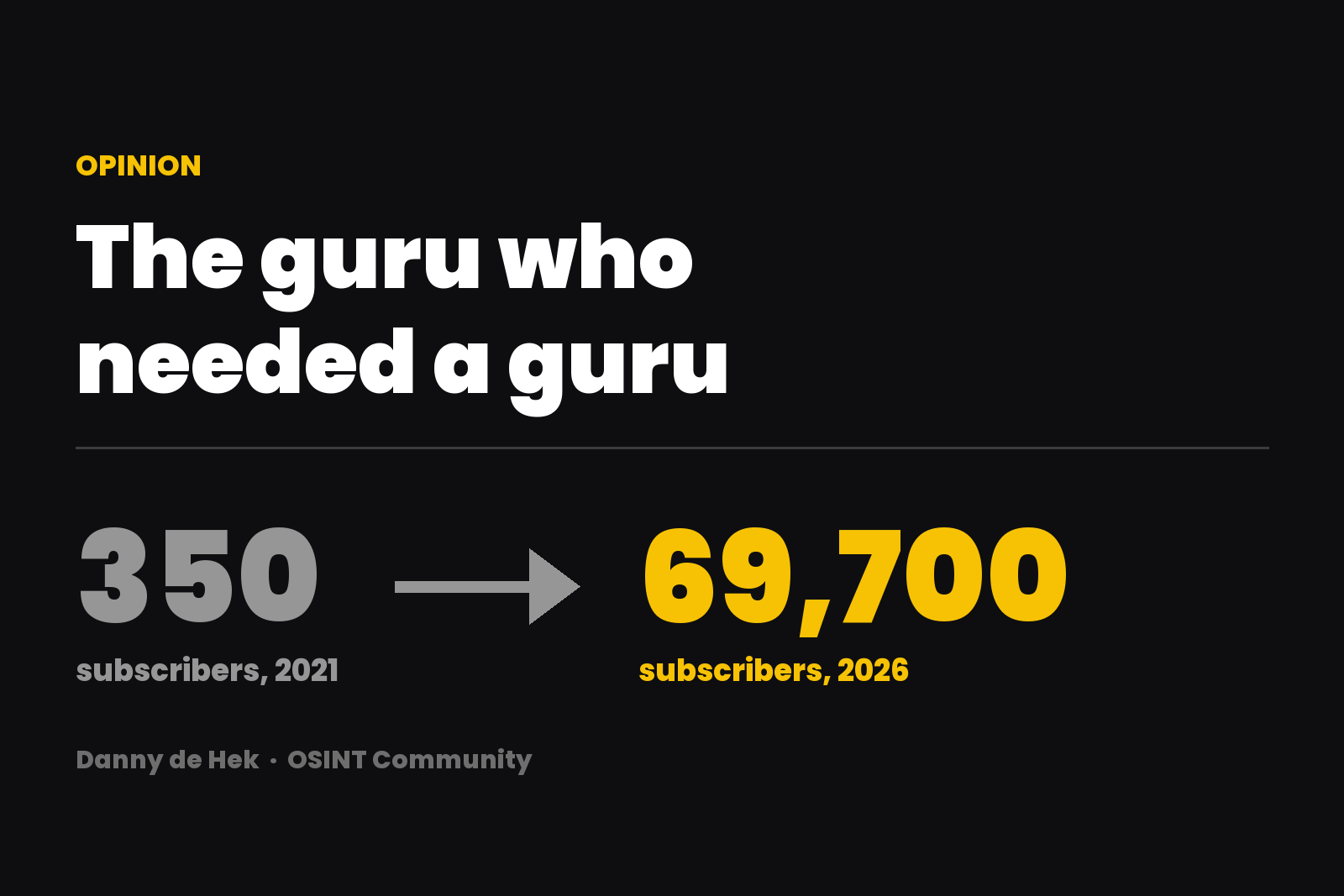
- The New York Times wrote in 2022 that the year before, he gave audience growth advice to 350 subscribers.
- His channel grew to 69,700 subscribers after he turned to naming alleged fraudsters.
- His livestreams draw in home addresses, spouses and children of the people he targets.
- Small errors get an editor's note; changes after legal letters come without a note saying what changed.
- The privacy rules in journalism matter most when the person being exposed seems to deserve it: that is when breaking them is most tempting, and when a mistake does the most harm to people who did nothing.
In 2021 Danny de Hek gave advice on how to grow an audience online. He had 350 subscribers. Today he has close to 70,000, and he did not get them by following his own advice. He got them by naming people. Along the way, his livestreams began to draw in the people around them.
Disclosure: The author owns 17 percent of ELF and is a party to a dispute inside it that de Hek has written about. He has worked with Lars Olofsson since 2022 and was a deputy board member of his company Prio Startup AB until 6 October 2026. No one commissioned or paid for this column. Full disclosure at the end. The facts about de Hek's methods are documented, with sources, in the two-part review published alongside it.
The question this column asks is an old one. Is it right to break the rules against people who deserve it? De Hek's career is a long answer in the affirmative. The rest of this piece is about where that answer leads.
The New York Times put it better than I can. Its 2022 profile described him as "a social media guru badly in need of a social media guru", a New Zealander who "dispensed advice about how to vastly expand your online audience, to a group of just 350 subscribers". He "earned a living by drop shipping electronics", the paper wrote.
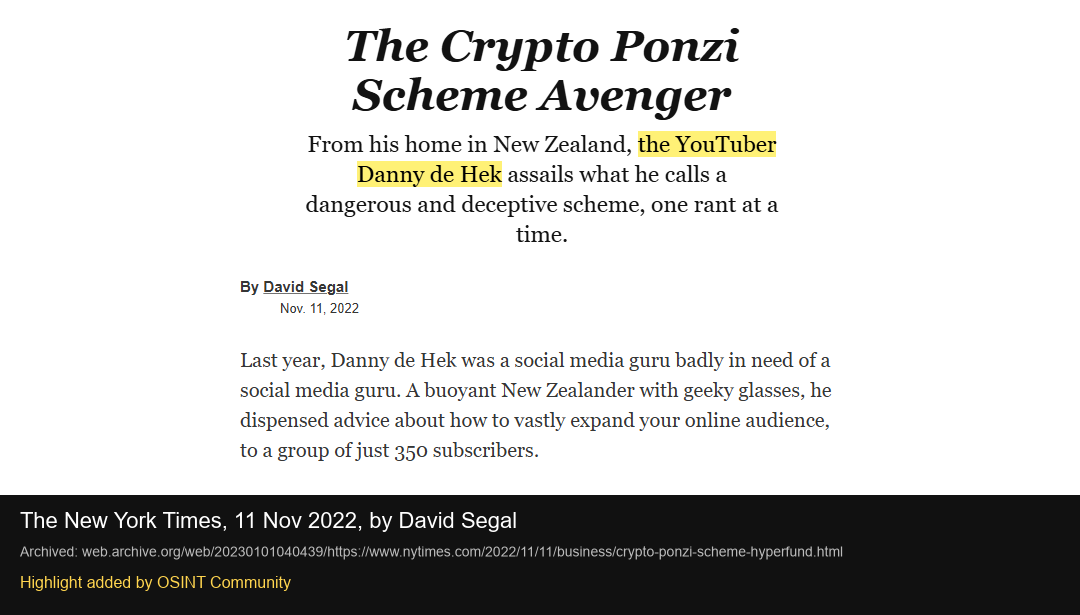
Then, in February 2022, a friend's husband sent him a pitch for HyperFund. He decided it was a scam, and he was right: US regulators later charged its founder with fraud. By March he had a new identity, the crypto Ponzi scheme buster, and a new kind of content. Within months the channel had 2,500 subscribers. By October 2026 it had 69,700, more than 1,300 videos and over a thousand livestreams.
The labels changed with the numbers. His own website, read through the Internet Archive, has presented him as the publisher of a tourist directory, a web designer, an "Entrepreneur, Connector and Influencer", a vigilante, an activist and a "Satirist Scam Fighter". On his home page the word journalist first appears in mid-2025. Today the title of his home page reads "NYT Featured Investigative Journalist". The New York Times called him a YouTuber.
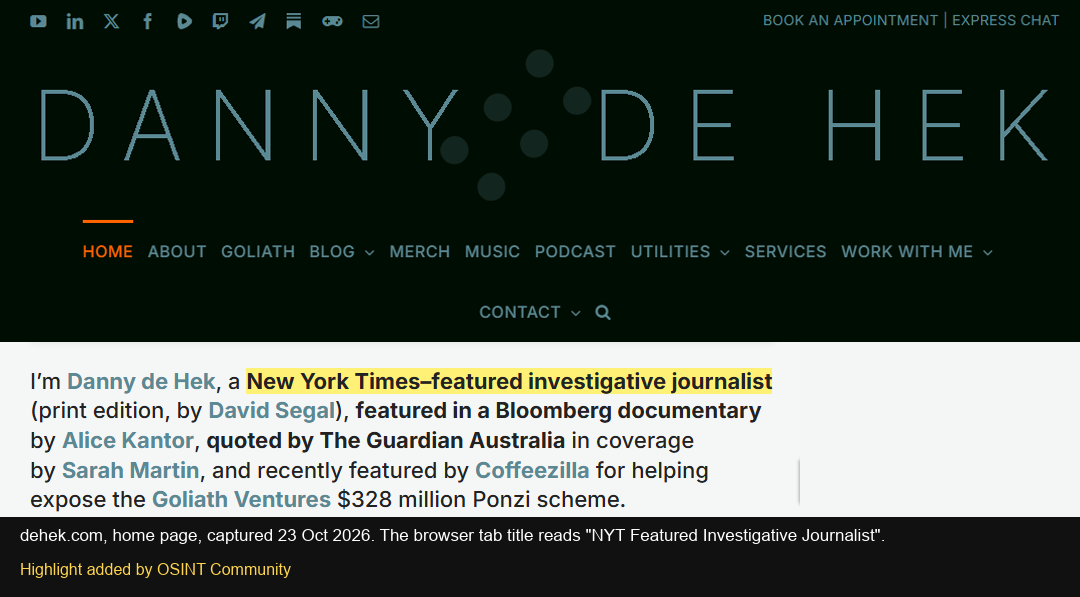
He has also worked on how others describe him. The Internet Archive first captured the "NYT Featured Investigative Journalist" title on 5 November 2025, about two weeks before a new Wikipedia article about him was accepted. He edited the article himself, asked on its talk page for the line calling him an online dropshipper to be replaced with one that mentioned dropshipping "alongside his work as an investigative journalist", and then urged his followers to "Correct it" and "Restore removed factual content". A Wikipedia editor removed "investigative journalist", noting that the source given did not call him one. The article now describes him as a New Zealand YouTuber.
None of that would matter much if it were only branding. It matters because of what grew the channel.
What the audience came for
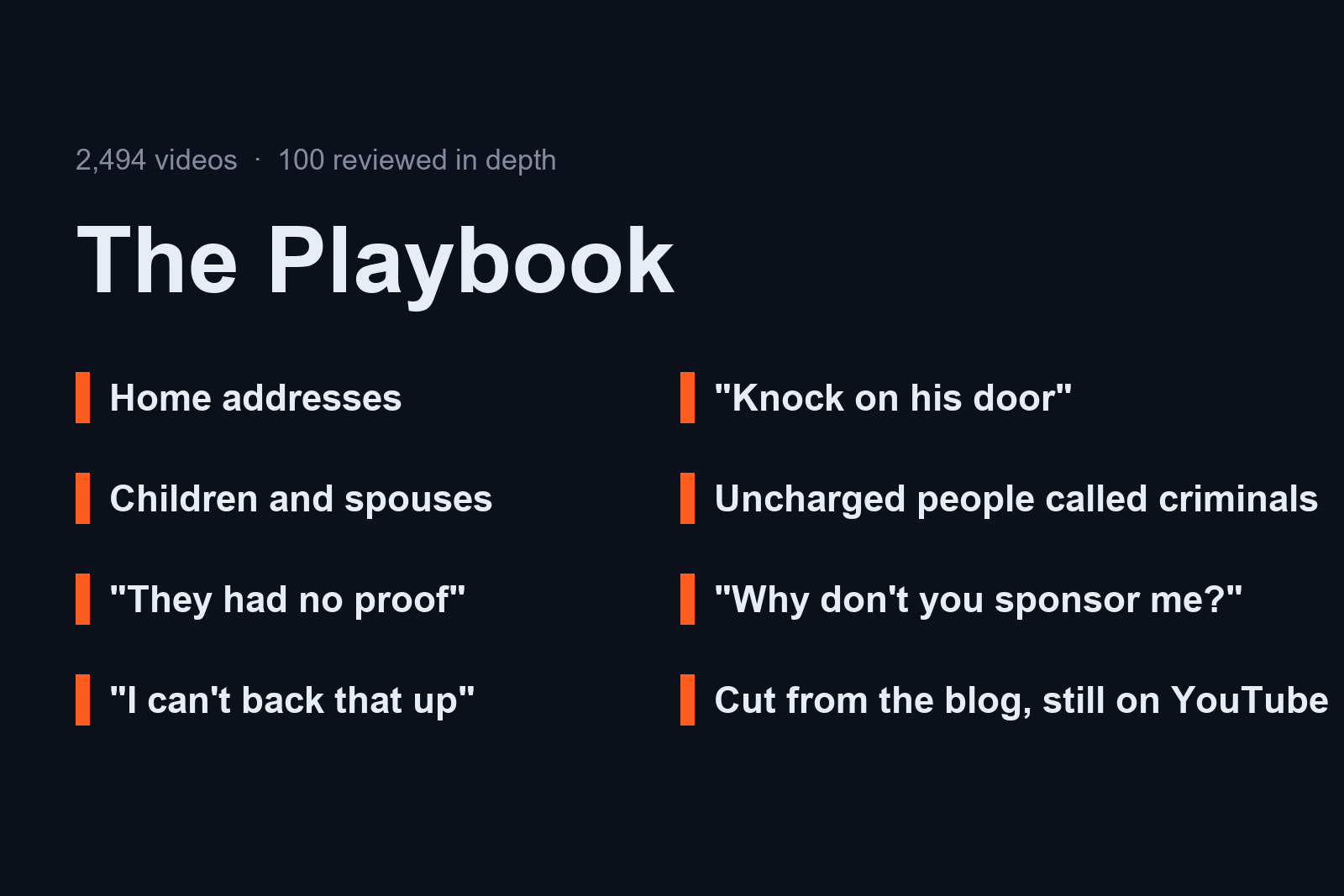
Watch enough of his livestreams and a format appears. A target is named. The target's home address goes up, or is offered to anyone who sends a message. Viewers are asked to share it, to film the house while walking the dog, to "video it when you go and knock on his door" (at 23:50). Then the circle widens. A promoter's spouse, her phone numbers and "where her children go to school" are requested for his database (at 19:21). To a promoter who had criticised him, he says: "when we found out where your daughter goes to university ... that shut you up" (at 1:03:30). Of an investor who wanted his money back from Stephen McCullah, he says he told him: "I know where his partner, his new wife lives, why don't you go give her a visit" (at 4:35). In one stream he leaves a voicemail for a woman he guesses is a promoter's daughter, saying, as a joke, that he is calling from the "Broadcast Government Department" and that her sister is "locked in the room" (at 3:34:00).
None of those relatives is accused of anything.
I understand the anger behind it. I have spent years on fraud cases, and I have sat with people who lost their savings, their pensions and in some cases their marriages to schemes run by people who smiled for the camera. The urge to make the guilty feel what their victims felt is human. De Hek has made a career of giving that urge a stage, and some of his targets deserved the scrutiny. Christopher Delgado of Goliath Ventures, whom de Hek pursued for months, pleaded guilty to wire fraud and money laundering in June 2026.
But the rules journalism has about privacy, children and harassment were not written for the easy cases. They were written precisely for the moment when you are sure the person in front of you deserves whatever comes. That is when they are needed, because that is when people stop checking.
Where it leads
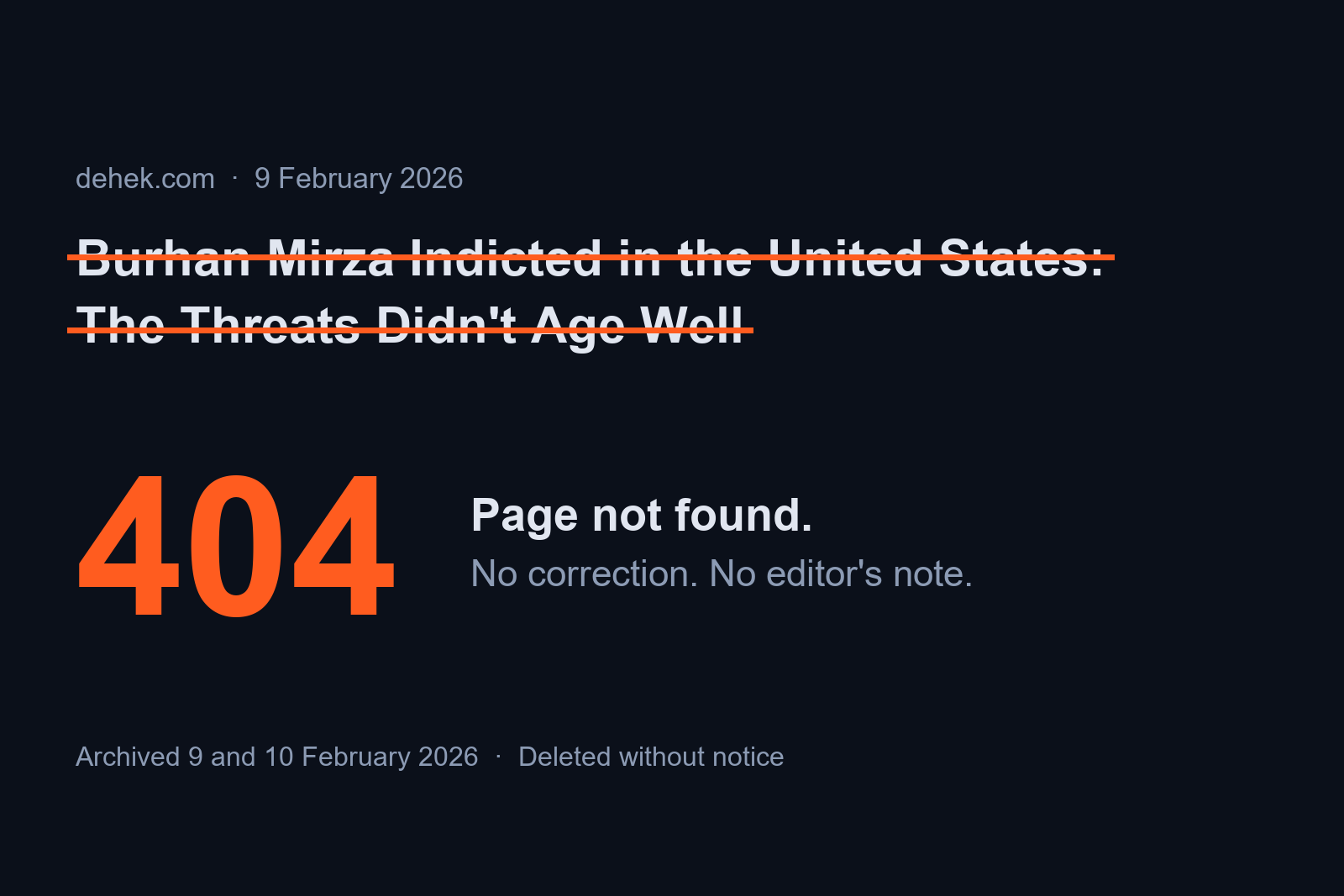
It leads to February 2026, when he told his readers that a man he had accused for months had been indicted in the United States, and illustrated it with an image of himself cheering. It was, in all likelihood, a different man. The Justice Department says the defendant is 31; the man de Hek had been writing about says he was born in 1981. The article was later deleted, without a correction.
It leads to a livestream where he says of one of his own claims: "I'll be honest, that particular statement, I can't back that up, but I know that that will cause major disruption" (at 1:19:41). In that moment, disruption, not accuracy, was the measure.
And it leads to a pattern in how he corrects himself. A wrong family relationship or the name of a real estate agency gets an editor's note and sometimes an apology. When a lawyer writes, whole passages and accusations can disappear and publish dates move, without a note saying what changed. He knows what a correction looks like. He uses it for the details.
The rules exist for the day you are wrong. De Hek had that day in February. He was certain enough to celebrate, and the man he celebrated over was, in all likelihood, not the man who had been charged. On another stream he states his rule: if it means publicising a home address, "then so be it". If that is the licence, it applies just as fully on the day you name the wrong person. Privacy rules, the protection of relatives and the duty to correct openly are not there for the targets who are guilty. They are there for everyone who turns out not to be.
Similar tools, different halo
Fraudsters and the people who hunt them are supposed to differ in method, not just in target. A fraudster leaves the cost with people who never agreed to carry it, and keeps quiet when it goes wrong. Publishing a man's home address and asking strangers to knock on his door also leaves the cost with people who never agreed to carry it: a family that is not accused of anything. Deleting the article that most likely named the wrong man, without a word to readers, is keeping quiet when it goes wrong. That does not make him a fraudster. It makes the methods harder to tell apart than the halo suggests.
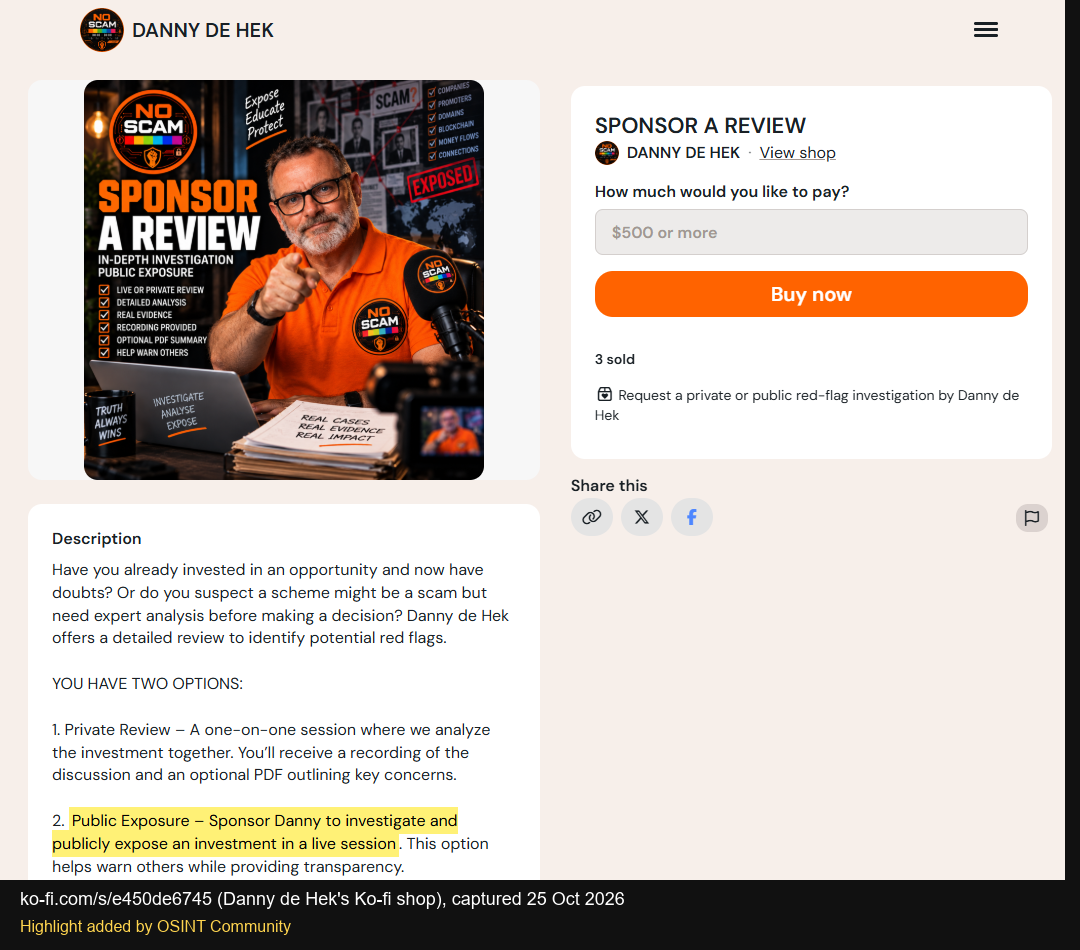
And exposure is for sale. His Ko-fi shop offers "Sponsor a Review" for US$500, three sold, with an option called "Public Exposure", described as "Sponsor Danny to investigate and publicly expose an investment in a live session". The price has risen from NZ$200 to NZ$850 in a year. In a live call with a self-described co-owner of TMX Global, a company he was investigating, he asked: "Why don't you sponsor me to do a review of your company?" (at 27:37). The company declined, and he published his findings anyway. Nothing we found shows that anyone paid to avoid or soften coverage. But a public shaming you can order and pay for is not journalism. It is a service.
When the methods are this close, what is left is the halo. And a halo is not a method.
By the halo I mean the sense of being the good guy in the story. It is real to him, and to his audience. But being on the right side is not a way of working. Journalism is judged by how it is done, not by how righteous the journalist feels or how guilty the target is. In practice, his rule is that deserving it is enough. That is the reasoning of everyone who has ever broken the rules for a good cause, and it is exactly the reasoning the rules were written to stop.
In his reply to our questions, de Hek wrote that he makes "no apology" for investigating people who may have caused serious financial harm, and that he "will not apologise for the legitimate investigative work" he has done. No one is asking him to apologise for investigating fraud. The question is whether going after wives, daughters and children's schools is part of that work. He wrote that relatives are not responsible for another person's alleged misconduct and that children's privacy "deserves particular protection". Asked whether his database holds information about children and their schools, he said he would not disclose the contents of confidential investigative databases.
The standard
I run OSINT Community on a simple line, and this review is the test of it. We investigate scams, networks and money. We do not go after families. We do not publish home addresses. We never put a child on the screen. Every person other than de Hek in the film that accompanies this review has been blurred. When we get something wrong, we say so, at the top of the page.
That is not a higher standard than the one de Hek claims. It is the same one. The difference is that we keep it even when breaking it would be easier.
A guru who could not grow his own audience found one by punishing people. The audience was real, and so were some of the crimes. But an audience is not a mandate, and being right about a Ponzi scheme does not make it right to urge strangers to a woman's front door.
Disclosure
The author, Daniel Johansson, is named in an article Danny de Hek published on 22 October 2026 (New Zealand time) about a dispute inside Eight Legged Forensics (ELF), a company in which the author owns 17 percent and with which he works; he is a party to that dispute. He accepted an offer of a 10 percent stake from a then co-founder of ELF in February 2025 and now holds 17 percent. The author was in contact with de Hek from November 2024 and supplied him with material.
OSINT Community was launched in October 2026. The author has investigated the hemp industry, where he also works, for several years, and started svenskhampa.se in 2026 to publish that work. Long before that, people were bringing him cases outside the industry. One was OmegaPro, published here first, with the response of the Dubai Sports Council. He had planned a separate site for such cases for some time. De Hek is part of the reason it launched when it did. Watching his broadcasts, the author concluded that this way of working would never hold up, and that open-source investigation needs a higher standard: sources linked in the text, corrections made openly at the top of the page, and no families, children or home addresses. This review is its first major piece. De Hek has pointed out on air that the site is new. He is right.
Since 2022 the author has worked publicly with Lars Olofsson on the JuicyFields case. Until 6 October 2026 he was a deputy board member (styrelsesuppleant) of Prio Startup AB, a company owned by Olofsson. He owned no part of it and received no income from the role, as he stated publicly in September 2026.
Before publication, Lars Olofsson sent de Hek a preview link to the first article in this review, with comments of his own. That was done without the author's knowledge. Olofsson had no role in researching, writing or editing this review, and his messages to de Hek are his own.
No one commissioned or paid for this column.
Read more: Danny de Hek: the corrections he made, and the ones he did not and Danny de Hek: The Playbook.
Frequently asked questions
How did Danny de Hek grow his YouTube channel?
According to the New York Times he had 350 subscribers in 2021, when he was giving social media advice. After he began exposing HyperFund in 2022 the channel grew to 2,500 subscribers that year and to 69,700 by October 2026.
Is this column part of the review of Danny de Hek?
It is an opinion piece. The facts about his methods, from the deleted Burhan Mirza article to the livestream quotes about addresses and relatives, are documented with sources and timestamped links in the two-part review published alongside it; other facts are linked in the text.
Does the column say Danny de Hek was wrong about everything?
No. It notes that he was right about HyperFund, whose founder US regulators later charged with fraud, and that Christopher Delgado of Goliath Ventures, whom he pursued, pleaded guilty in June 2026. The argument is about his methods: home addresses, relatives and silent corrections.
Read more
Danny de Hek: The Threats Didn't Age Well. Neither Did the Article.
On 9 February 2026 Danny de Hek told his readers that a man he had accused for months had been indicted in the United States. The indicted man appears to be…
Danny de Hek: The Playbook
Danny de Hek's own videos show him publishing home addresses, urging viewers to knock on doors, asking for the schools of a promoter's children and asking a…